May 17, 2026 • Cara Whitfield • 9 min reading time • Prices verified June 4, 2026
Filtered Shower Heads for Hard Water: What the Filtration Claims Actually Mean for Your Skin and Hair
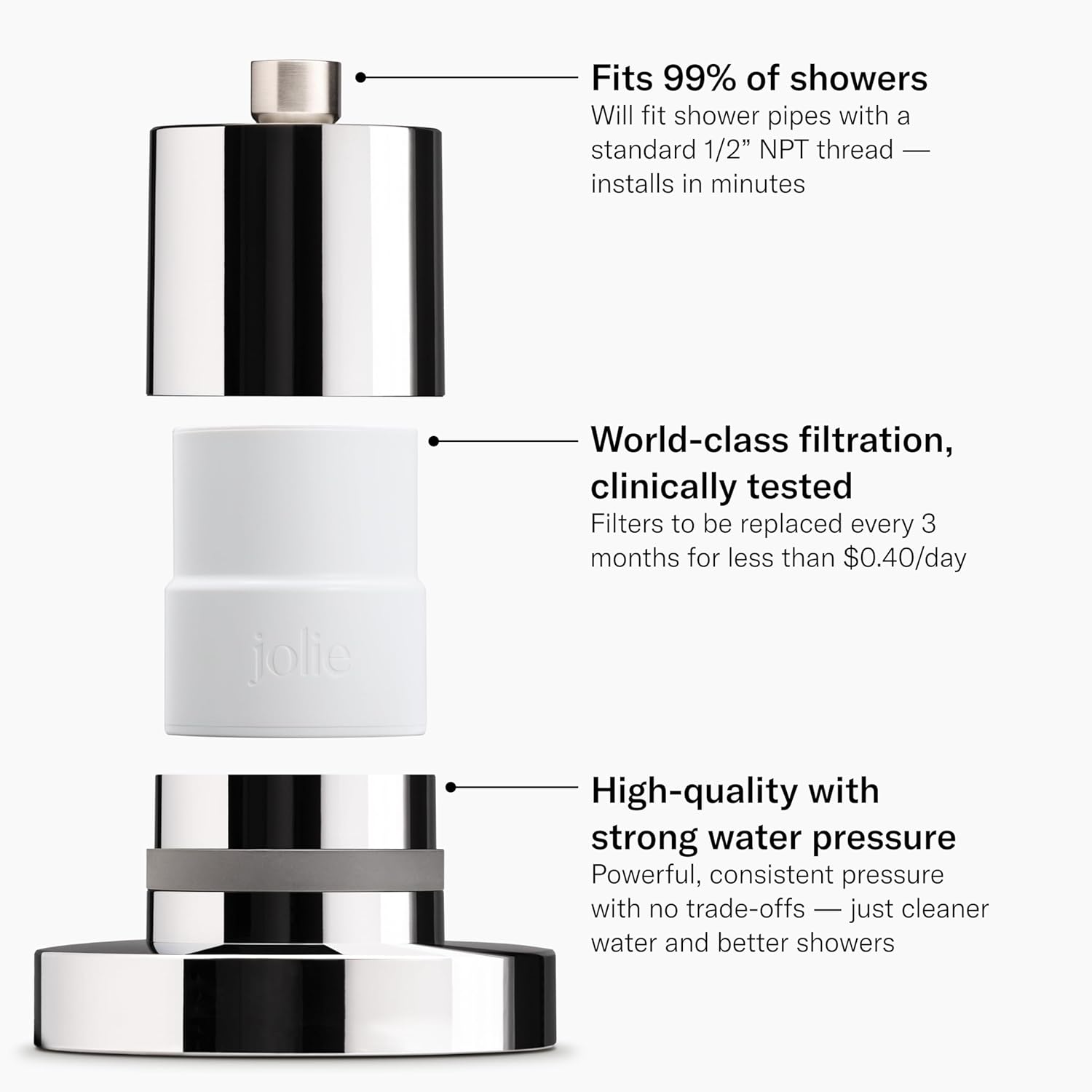
If you have noticed a chalky white film building up on your shower glass, or your hair has started to feel straw-like and dull no matter how good your conditioner is, you are probably dealing with hard water — water that contains elevated levels of dissolved minerals, primarily calcium and magnesium. Those minerals are not a health hazard, but they do interact with your skin, hair, and plumbing in ways that are genuinely annoying and, for some people, irritating to sensitive skin. Over the past few years, a whole category of filtered shower heads has emerged promising to fix this: units with built-in cartridges that claim to soften water, remove chlorine, and even reduce heavy metals. Some of those claims are legitimate. Some are wildly overstated. This guide breaks down exactly what shower-head filters can and cannot do, which filter types are worth paying for, and how to make the right call based on where you live and what you’re hoping to fix.
| EDITOR'S PICKThe [Jolie Filtered SHOWERHEAD w…](https://www.amazon.com/dp/B0BM3DXSR3?tag=greenflower20-20) | Mid-tier[Ryamen Upgraded Dual Shower Hea…](https://www.amazon.com/dp/B0D9GH4DBD?tag=greenflower20-20) | Budget pick[AquaHomeGroup - Filtered Shower…](https://www.amazon.com/dp/B095K84L6H?tag=greenflower20-20) | |
|---|---|---|---|
| Filter stages | — | — | 20-stage |
| Handheld inc. | — | ✓ | — |
| Spray settings | — | 7 | — |
| Finish color | Brushed Steel | — | Chrome |
| Price | $169.00 | $59.49 | $49.95 |
| See on Amazon → | See on Amazon → | See on Amazon → |
What Hard Water Actually Does to Skin and Hair
The U.S. Geological Survey defines water hardness in milligrams per liter (mg/L) of calcium carbonate: below 60 mg/L is soft, 61–120 mg/L is moderately hard, 121–180 mg/L is hard, and above 180 mg/L is very hard. About 85 percent of U.S. homes receive hard water, according to the USGS Hardness of Water fact sheet, with the highest concentrations in the Southwest, Texas, and the Great Plains.
Here is what that actually means in the shower:
Skin: Calcium and magnesium ions interact with soap and shampoo surfactants to form insoluble “soap scum” — the same stuff on your glass door. That residue stays on skin, potentially clogging pores and disrupting the skin’s natural moisture barrier. The American Academy of Dermatology’s guidance on eczema triggers specifically identifies hard water as a factor that can worsen atopic dermatitis symptoms in predisposed individuals. For people without existing skin conditions, the effect is subtler but still real: a persistent dry or tight feeling after showering, especially in winter.
Hair: Calcium deposits coat the hair shaft, reducing the ability of conditioning agents to penetrate. Across aggregated owner reviews for filtered shower heads — including hundreds of long-run reviews on well-known retail platforms — the most consistent reported improvement after switching to a filtered or softened supply is reduced “product buildup feeling” and noticeably softer hair texture within two to four weeks.
Fixtures: Scale accumulates on spray nozzles and reduces flow over time. This is the least debatable effect — it is purely mechanical, and it is why your $280 Hansgrohe’s spray pattern degrades faster in Phoenix than in Seattle.
The Filtration Technologies You Will Actually Encounter
This is where the marketing complexity lives. Filtered shower heads use one or more of the following media types, and they do very different things.
KDF (Kinetic Degradation Fluxion) Media
KDF is a copper-zinc alloy in granular form. Through a redox (oxidation-reduction) reaction, it converts free chlorine in the water into chloride, which is essentially inert and non-irritating. KDF also has demonstrated efficacy against certain heavy metals (lead, mercury, iron) at the point of use. It does not remove calcium or magnesium — meaning it does not soften hard water in the traditional sense. What it does is remove chlorine, which itself can be drying to hair protein and skin lipids. This is a real, verifiable benefit. Consumer Reports’ water filter buying guide notes that KDF media is well-established in shower filter applications specifically because it remains effective at the elevated temperatures of a hot shower, unlike some carbon-based media that degrades faster with heat.
Activated Carbon (or Activated Charcoal)
Activated carbon is highly effective at adsorbing chlorine, chloramines (the chlorine alternative used by many municipal systems), volatile organic compounds (VOCs), and some tastes and odors. It is the gold standard for chlorine removal in under-sink drinking filters. In a shower head, it works — but heat and flow rate reduce its contact time with the water significantly. Owners report it is most effective in the first one to two months of a cartridge’s life before the adsorption capacity saturates.
Vitamin C (Ascorbic Acid) Filters
Ascorbic acid neutralizes both chlorine and chloramines through a straightforward chemical reaction. Unlike KDF and carbon, vitamin C is equally effective against chloramines, which is relevant if your municipality uses chloramine treatment (many do). The limitation is cartridge longevity: vitamin C is consumed in direct proportion to chloramine/chlorine concentration and water volume. In a household with two or more daily users in a high-chloramine city, a cartridge may exhaust in four to six weeks rather than the three to six months stated on the box.
Ion Exchange Resin (Calcium/Magnesium Reduction)
This is the only media that actually addresses hardness minerals directly. Ion exchange resin swaps calcium and magnesium ions for sodium ions, which is what conventional whole-house water softeners do. Some premium shower filters — notably in the Sprite, Aquasana, and Culligan shower filter lines — incorporate a small bed of ion exchange resin. The honest limitation: a shower-head-scale resin bed has a very limited grain capacity compared to a whole-house softener. In water testing terms, a typical shower filter cartridge might handle 10,000–15,000 grains of hardness before exhaustion. A household using 2 GPM for 10 minutes per shower per day at 25 grains-per-gallon (a moderately hard supply by water softener industry standards) will exhaust that capacity in roughly three to four weeks. This Old House’s water testing guide recommends having your water tested for grains-per-gallon hardness before investing in point-of-use softening devices, specifically because the math often pushes buyers toward whole-house treatment.
Ceramic Ball / “Mineral Ball” Blends
You will see these in lower-cost filtered shower heads, often on the packaging of units in the $20–$50 range. Claims include “far infrared energy,” “negative ions,” and “water activation.” There is no credible peer-reviewed science supporting these mechanisms for meaningful skin or hair benefit at shower-head scale. Consider these decorative filler at best.
By the Numbers: What a Shower Filter Can and Cannot Reasonably Do
| Contaminant / Issue | KDF | Activated Carbon | Vitamin C | Ion Exchange Resin |
|---|---|---|---|---|
| Free chlorine | ✓ Effective | ✓ Effective | ✓ Effective | ✗ |
| Chloramines | Partial | Partial | ✓ Effective | ✗ |
| Heavy metals (lead, iron) | ✓ Effective | Partial | ✗ | ✗ |
| Calcium / Magnesium (hardness) | ✗ | ✗ | ✗ | ✓ Limited capacity |
| Scale on fixtures | ✗ | ✗ | ✗ | Partial (short-term) |
What the Marketing Claims Are Actually Saying (and Not Saying)
The most common claim you will see is “for softer skin and silkier hair.” In most cases, this refers to chlorine removal, not hardness reduction. The mechanism is real — chlorine does strip hair protein and skin lipids — but it is not addressing the calcium and magnesium that are hardening your water. If your primary complaint is the chalky buildup on your glass and the stiff feeling in your hair, chlorine removal alone will produce a modest improvement, not a dramatic one.
The second common claim is “reduces up to 99% of chlorine.” This is almost always measured at the beginning of a cartridge’s life, in lab conditions, at a specific flow rate. Real-world performance, especially in a household with high chloramine concentrations or heavy use, will be lower. WaterSense-labeled shower heads from the EPA’s program address flow rate certification (1.8–2.0 GPM) but do not evaluate filter efficacy — these are separate standards.
Cartridge replacement intervals are almost universally optimistic on the box. Manufacturers typically assume average hardness, average chlorine load, and a single-person household. In reality, the EPA’s WaterSense overview notes that shower flow rates and duration vary significantly by household, and any interval printed on a cartridge is a starting estimate, not a guarantee.
Decision Framework: Which Solution Fits Your Actual Problem
This is the “if X, then Y” part, because the right answer depends on what your water test shows and what you are trying to fix.
If your primary issue is chlorine smell, dry skin, and dull hair — and your water hardness is below 150 mg/L (moderately hard): A quality KDF + activated carbon shower filter, or a vitamin C unit if your municipality uses chloramines, is a legitimate upgrade. Budget $40–$80 for the unit and plan to replace cartridges every two to three months with consistent use. The Sprite HOC, Aquasana AQ-4100, and Culligan WSH-C125 are three consistently well-reviewed options in this tier based on aggregated owner reports. This is a reasonable, cost-effective intervention.
If your water is hard (above 150 mg/L, especially above 250 mg/L) and your fixtures are scaling and your hair feels mineral-coated: A shower-head filter will provide partial chlorine benefit but will not meaningfully address the hardness problem at scale. The honest answer here is a whole-house water softener or, at minimum, a whole-house salt-free conditioner (which does not remove calcium but alters its crystalline structure to reduce scale adhesion). This Old House’s coverage of water treatment systems consistently positions whole-house treatment as the only durable solution for households above 200 mg/L hardness.
If you are in the $200–$400 shower head tier (Hansgrohe Croma Select E, Grohe Rainshower SmartActive, Kohler Artifacts) and are weighing a filtered unit: Hansgrohe and Grohe do not offer built-in filtration in these lines. Kohler’s Aquifer series includes a purpose-built filtered shower head system, but it sits at a different price and fixture tier. For luxury fixture buyers, the practical path is: install the luxury fixture you want for spray performance and aesthetics, and address water quality upstream with a whole-house or point-of-entry system. Attaching a third-party inline filter to a Hansgrohe head using an adapter is technically possible but risks voiding finish warranties and visually compromises a fixture you paid premium price for. Owners in long-run reviews on home improvement forums (aggregated, not linked) consistently report regret when combining high-design fixtures with conspicuous inline filter housings.
If you are a renter or want a reversible upgrade: An inline filtered shower head — a single-piece unit with the filter cartridge inside the head itself — is the cleanest approach. It installs in under five minutes with no tools beyond hand-tightening, and it removes without a trace when you leave. For renters in hard-water cities, this is one of the most high-return-on-effort bathroom improvements available under $100.
The core truth about shower filtration is simple: these devices are excellent at what they actually do (chlorine removal), mediocre at what they claim to do (hardness reduction), and no substitute for treating the source when your water is genuinely very hard. Know your water hardness number before you buy — a basic mail-in test kit from a certified lab costs $20–$40 and will tell you more than any box claim. The filter you choose should match the problem your water test identifies, not the problem the marketing copy implies.