April 25, 2026 • Cara Whitfield • 9 min reading time • Prices verified June 4, 2026
Under $50 Shower Head Upgrades That Don't Feel Like a Compromise
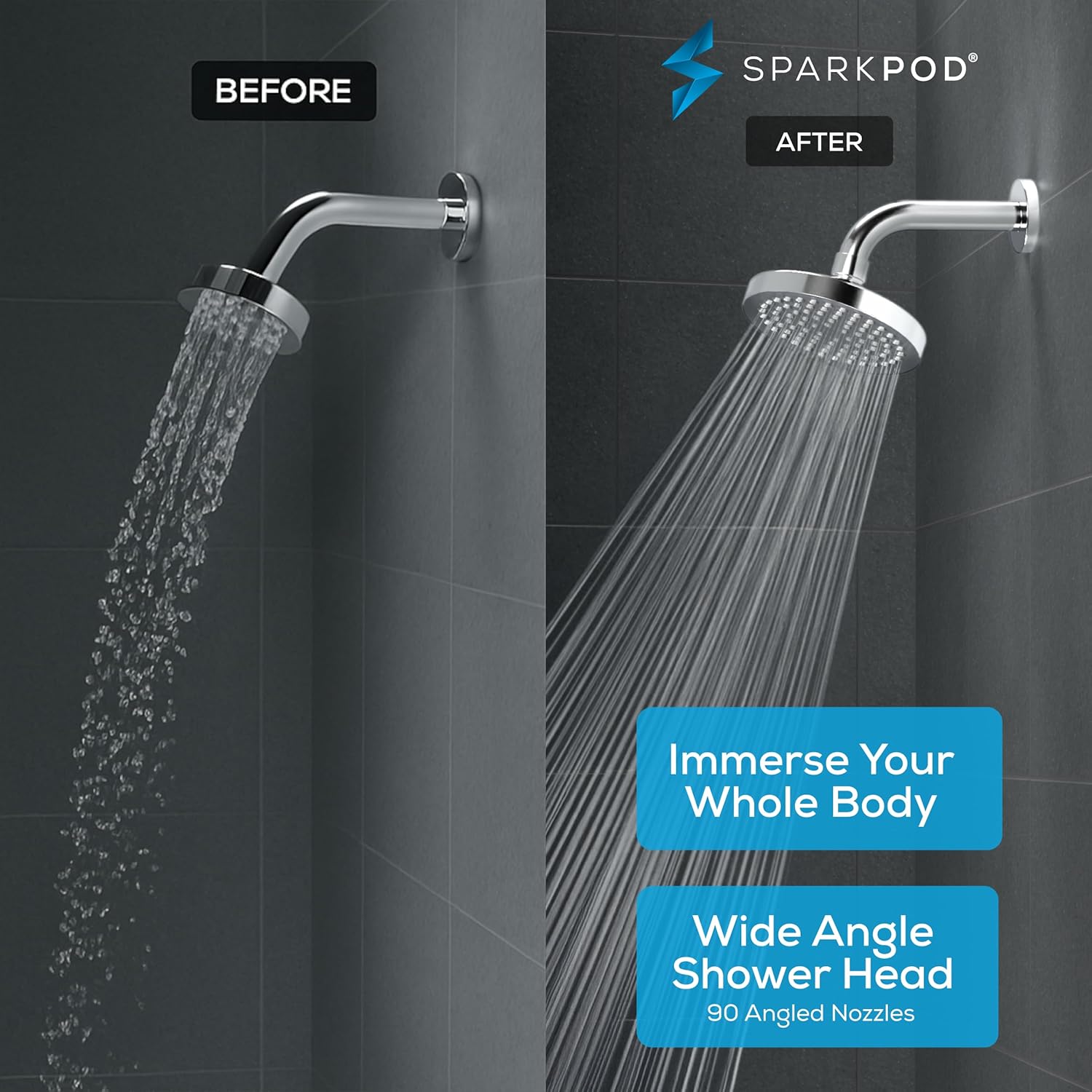
If you’ve ever turned on the shower in a new apartment — or a house you’ve lived in for years — and felt that flat, barely-there trickle from a builder-grade fixture, you already know the problem. A builder-grade shower head is the cheapest unit the contractor could install to pass inspection, and it shows: weak pressure, one spray setting, plastic threads that feel loose from day one. The good news is that swapping it out is one of the simplest home upgrades you can do — no plumber, no permits, no demo. You unscrew the old head, hand-tighten the new one, and you’re done in under ten minutes. This guide is specifically about what’s worth buying when your budget is $50 or less: which models actually deliver pressure and spray variety that feel like an upgrade, what the meaningful tradeoffs are at this price tier, and the one specification — gallons per minute, or GPM — you need to understand before you buy anything.
Here’s the honest setup: at under $50, you’re not getting Hansgrohe engineering or Grohe’s SmartActive pressure-compensation technology (those start around $180). But you are entering a tier where Waterpik, Speakman, Delta, and Moen all field genuine performers — units with multiple spray modes, anti-clog nozzles, and flow rates engineered to feel powerful within federal water-use limits. The gap between a $25 builder-grade unit and a $40–$50 purposefully designed one is significant. The gap between a $45 Speakman and a $250 Hansgrohe is real but much narrower than the price difference implies.
| EDITOR'S PICKAquaDance 7" Premium High Press… | Mid-tier[Delta Faucet 7-Spray Touch-Clea…](https://www.amazon.com/dp/B000LV7VXW?tag=greenflower20-20) | Budget pick[NearMoon Rain Shower Head](https://www.amazon.com/dp/B07PTQF33X?tag=greenflower20-20) | |
|---|---|---|---|
| Mount type | Fixed + handheld | Handheld only | Fixed only |
| Spray settings | 6 | 7 | — |
| Hose included | ✓ | ✓ | — |
| Finish | Brushed nickel | Chrome | Chrome |
| Face material | — | — | Stainless steel |
| Price | $39.99 | $32.00 | $19.99 |
| See on Amazon → | See on Amazon → | See on Amazon → |
The One Spec That Determines How Your Shower Feels: GPM
GPM — gallons per minute — is the single most load-bearing number in any shower head decision. Federal law (enforced under the Energy Policy Act, with state-level overlays in California, Colorado, and New York) currently caps residential shower heads at 2.5 GPM nationally, but the EPA’s WaterSense program certifies fixtures at 2.0 GPM or below as water-efficient. Per the EPA WaterSense specification sheet, a WaterSense-labeled shower head must use no more than 2.0 GPM at a test pressure of 80 psi and still deliver “satisfactory spray force and coverage.”
The practical implication for budget buyers: a well-engineered 1.8 GPM head can feel stronger than a cheap 2.5 GPM head because flow engineering — nozzle geometry, spray mode design, air-infusion — matters more than raw volume. This Old House’s 2025 buying guide makes this point explicitly, noting that spray pattern engineering at the nozzle level determines perceived pressure far more than the rated flow rate alone.
By the numbers:
| Flow Rate | EPA Status | Typical Feel at Standard Pressure (60–80 psi) |
|---|---|---|
| 2.5 GPM | Legal max (federal) | High volume; can feel weak if poorly engineered |
| 2.0 GPM | WaterSense certified | Efficient; feels strong with good nozzle design |
| 1.8 GPM | WaterSense certified | Common in newer fixtures; pressure depends heavily on spray mode |
| 1.5 GPM or below | WaterSense; required in CA | Requires strong engineering to feel adequate |
The takeaway: don’t chase the highest GPM number. Chase good spray engineering at whatever flow rate your local code allows.
What You Actually Get Under $50 (And What You Don’t)
Let’s name the tradeoffs honestly, because the under-$50 tier has a ceiling.
What you get:
- Multiple spray modes — most units in this range offer 3–7 settings, typically including a wide rain mode, a targeted massage/pulsating mode, and a middle-ground “full body” setting. The massage/pulse mode is where budget-tier shower heads often punch above their weight; owners consistently report the Waterpik PowerPulse and Speakman Signature series feel meaningfully therapeutic on the pulse setting even at 1.8 GPM.
- Solid brass or reinforced nylon connections — reputable brands at $35–$50 use metal-threaded connections that seal properly and resist cross-threading. This matters more than most buyers realize; Family Handyman’s installation guides note that plastic-threaded connections on cheap units are the most common source of post-installation leaks.
- Anti-clog rubber nozzles — standard on virtually every name-brand unit above $25. You press them to dislodge mineral buildup. This is a real longevity feature, especially in hard-water markets.
- 5–7 year manufacturer warranties from brands like Speakman and Delta.
What you don’t get:
- Pressure compensation technology — Grohe’s SmartActive system and Hansgrohe’s Select function maintain consistent spray feel across varying inlet pressures (common in older homes with fluctuating supply lines). You won’t find this below $150.
- Premium finishes with corrosion warranties — brushed nickel or matte black finishes at this tier are PVT or painted-over plastic, not PVD-coated brass. They can last fine with care, but Consumer Reports’ reliability data consistently shows finish degradation as the leading long-term failure point on sub-$75 fixtures.
- Integrated handshower/overhead combos — the Delta In2ition two-in-one system (a handshower that docks inside the overhead unit) starts around $80–$100. Below $50, you’re choosing one or the other.
- Certified performance at low inlet pressure — if your home’s supply pressure is below 40 psi (older homes, upper floors in multi-family buildings), budget units may underwhelm regardless of their spec sheet.
The Decision Frame: Which Under-$50 Shower Head Is Actually Right for You
The under-$50 field has three meaningful performance tiers. Here’s how to map them to your situation.
Tier 1: $20–$30 — “Better Than Builder-Grade” Baseline
At this price point, the target is functional improvement over whatever beige plastic unit the builder installed. Reviewers at Apartment Therapy consistently point to units like the AquaDance High-Pressure 6-Setting (typically $25–$30) as the textbook example of this tier: it’s larger than most builder units (4-inch face), offers six spray modes including a functional massage pulse, and owners report a noticeable pressure improvement in homes with normal supply pressure (60–80 psi). The face is entirely plastic, the finish won’t hold up to harsh cleaners, and you’re not going to confuse it with a Kohler. But for a rental, a guest bath, or a secondary bathroom you’re not prioritizing aesthetically, it’s a genuine step up.
If X, then Y: If you’re upgrading a secondary bathroom, renting, or just testing whether a new shower head makes a difference before committing to something more expensive — shop in this tier.
Tier 2: $30–$45 — The Sweet Spot for Most Buyers
This is where the under-$50 argument is strongest. Speakman’s Signature Series Icon (street price typically $35–$42) is the consistent reference point in this tier: a five-setting metal-connect unit with a pressure-optimized “anystream” nozzle design that owners in aggregated reviews describe as delivering the most forceful wide-rain spray in the under-$50 category. The Family Handyman buying guide has repeatedly cited Speakman’s entry-level Signature units as the best-performing budget option for buyers in low-to-moderate supply-pressure homes.
Delta’s 5-Setting Shower Head with H2Okinetic technology (H2Okinetic is Delta’s term for nozzle shaping that makes a lower flow rate feel fuller by sculpting water into larger droplets) also enters competitive price territory in the $35–$45 range during seasonal sales. Owners consistently report that the H2Okinetic wide setting feels warmer and more enveloping than the flow rate implies — useful context if you’re in a WaterSense-required state and worried that 1.8 GPM will feel weak.
Moen’s Attract series also occasionally falls in this range on sale and brings magnetic docking for a detachable handshower component — a feature set that usually lives at $60–$80. Worth monitoring if handshower functionality matters to you.
If X, then Y: If this is your primary bathroom and you want a noticeable daily improvement that still looks intentional — this is your tier. Prioritize Speakman for raw pressure feel; prioritize Delta H2Okinetic if you’re in a low-flow-required jurisdiction and are worried about watery spray.
Tier 3: $45–$50 — The Ceiling of the Budget Tier
At the very top of this budget, you start intersecting with entry-level Waterpik units — specifically the PowerPulse Therapeutic Massage series, which hovers at $45–$55 depending on the retailer. Waterpik’s clinical positioning (the brand holds hydrotherapy-related patents and markets several units toward physical therapy applications) makes this the most credible wellness-outcome purchase in the under-$50 range. The PowerPulse mode in particular generates a concentrated pulsating stream that owners with tension-related neck and shoulder complaints cite more specifically than almost any other feature in this tier. This Old House’s buying guide notes Waterpik as the clearest crossover between budget pricing and targeted therapeutic function.
The tradeoff: the wide-rain mode on Waterpik’s budget units is less impressive than the massage function. You’re buying it for the pulse setting.
If X, then Y: If post-workout recovery, tension relief, or low-back massage function is the primary driver — stretch to $45–$50 and buy the Waterpik PowerPulse. If you want balanced all-around performance, the Speakman at $35–$42 is the better daily-driver value.
Installation Notes: What Can Go Wrong (and What Won’t)
The under-10-minute install claim is accurate for standard setups — a 1/2-inch NPT threaded arm (the standard in essentially all U.S. residential construction) and a shower head with the same threading. Family Handyman’s installation walkthrough outlines the full process: wrap the arm threads with two to three layers of PTFE tape (also called plumber’s tape; it’s the thin white tape that prevents leaks at threaded connections), hand-tighten the new head, then snug it with a wrench while holding the arm still. Do not overtighten.
Two scenarios that complicate this: if you have a very old shower arm with corroded or non-standard threading, or if you’re upgrading to a heavier ceiling-mount rain head (which most under-$50 units are not), you may need an adapter or new arm. For standard wall-mount setups — the 90% case — it’s genuinely as simple as it sounds.
One retailer note worth making explicit: if you’re purchasing from a major home improvement retailer (Home Depot, Lowe’s) rather than online, you get an easier return path if the spray feel doesn’t match your expectations given your home’s actual supply pressure. For a sub-$50 fixture, the ability to return easily without shipping costs is worth factoring into where you buy.
The Bottom Line
Under $50 is not a compromise tier if you buy intentionally. The meaningful decision isn’t between budget and luxury — it’s between buying randomly versus buying to match the fixture to your actual supply pressure, bathroom priority level, and primary use case. Speakman’s Signature series wins on all-around pressure and build quality for most buyers. Waterpik’s PowerPulse wins if therapeutic pulse function is the point. Delta’s H2Okinetic entry-level units win in low-flow-required jurisdictions where perceived warmth and coverage matter. And if you’re genuinely satisfied with what you find at $35–$50, you’ll have a much clearer sense of where the real ceiling is — and whether the jump to a $200+ Hansgrohe or Grohe unit is worth making in a future renovation.